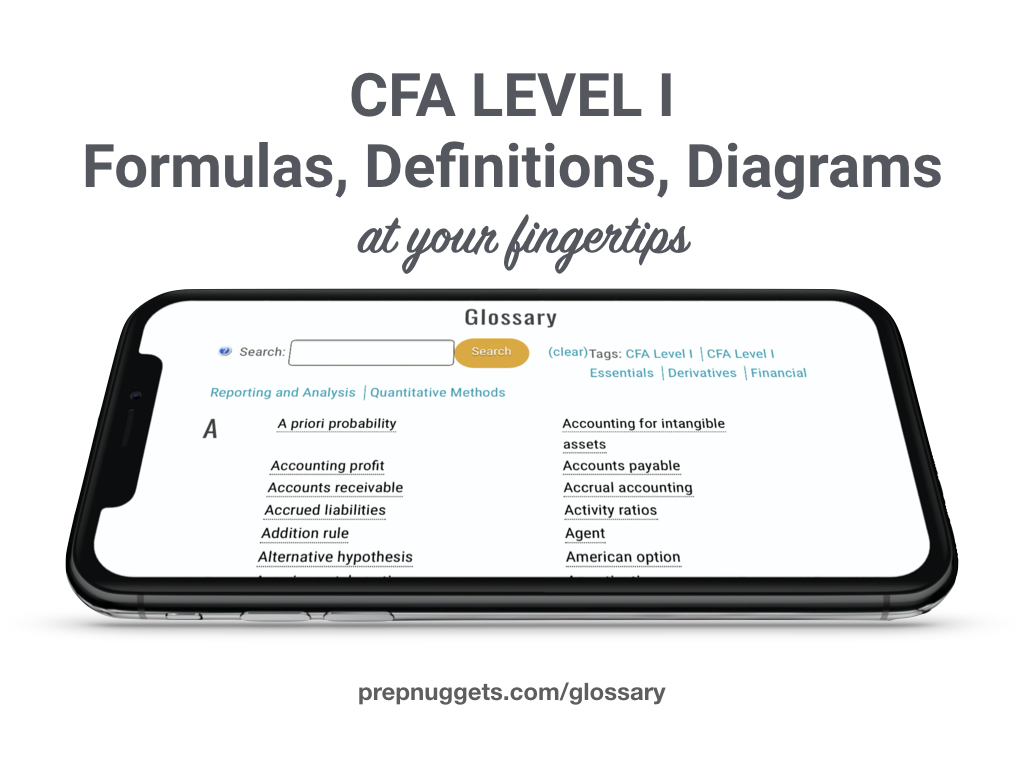
Quick reference items are fully complete for all Level I CFA® topics.
Call market
A secondary market in which trades occur only at a particular time and place. All interested buyers and sellers of a stock gather at a specific time and place to declare their bids and asks, and then one negotiated price is set that clears the market for the stock. A call market can be very liquid when in session because ...
Call money rate
The interest rate that buyers pay for their margin loan in a leveraged position.
Call option
An option contract that gives the LONG the right to BUY an underlying asset from the SHORT at the exercise price, but no obligation to. The SHORT is required to SELL at the exercise price, if LONG exercises the right to buy. Value of European option (CALL) at expiration: CT = max(0, ST-X) ST: Spot price at expiration X: Exercise ...
Call protection period
Some callable bonds are issued with a call protection period which prohibits the issuer from calling a bond early in its life. It is an assurance to investors that they will receive the promised yield for at least this period.
Call provision
An embedded option of a callable bond that gives the issuer the right to redeem all, or part of the bond, before the specified maturity date. Callable bonds present investors with a higher level of reinvestment risk than non-callable bonds. As such, callable bonds have to offer a higher yield than otherwise similar non-callable bonds. Some callable bonds come with ...
Candlestick chart
Like a bar chart, but displays a box bounded by the opening and closing prices. If the opening price is higher than the closing price, the bar is filled. The solid line in the middle represents the range for that time period.
Cannibalisation
When an investment takes customers and sales away from another part of the company. See also: Externality
Capital Account
A component of the balance of payments account that measures transfers of capital. Under capital account, imports and exports of non-produced, non-financial assets, such as the rights to natural resources, are recorded in this sub-account. This also includes the sale and purchase of intangible assets, such as patents, copyrights, trademarks, franchises, and leases. Capital transfers include debt forgiveness, and assets ...
Capital Allocation Line
A straight line that describes the combinations of expected return and standard deviation of return available to an investor from combining the optimal risky portfolio with the risk-free asset. Ideally, this line should be as steep as possible. A steeper line means that the investor gets more return per extra unit of risk taken. The capital allocation line is steepest ...
Capital Asset Pricing Model
Required rate of return for a stock is a function of the risk-free rate, its systematic risk (β), and the expected return on the market. One of the methods for estimating the cost of equity. See also: WACC
Capital market expectations
The first stage of the portfolio construction process where the investor’s expectations concerning the risk and return prospects of asset classes are determined. Historically, only the broad categories of equities and bonds were considered. More recently, alternative investments have gained more prominence. Alternative investment asset classes include hedge funds, private equity funds, commodities and real estate. Overall, the asset classes ...
Capital Market Line
Based on the simplifying assumption that investors have homogeneous expectations, all investors face the same efficient frontier of risky portfolios, and will all have the same optimal capital allocation line. This optimal CAL is termed the Capital Market Line (CML). See alsoL CAL, efficient frontier
Capital protected instruments
A category of structured financial instruments which offers a guarantee of a minimum value at maturity, as well as some potential upside gain. See also: Guarantee certificate
Capital rationing
Firms have constraints on the amount of capital they can raise and must use capital rationing. If the profitable opportunities exceed the amount of funds available, the firm must prioritise its project selection to achieve the maximum shareholder value, subject to the funding constraints.
Capitalisation
When a cost is capitalised, it is recorded initially in the balance sheet as an asset. This cost is depreciated or amortised over the asset’s useful life. In general, capitalise only if there is a future economic benefit.
Capitalisation rate
In the context of real estate valuation, the cap rate of Cap rate = Discount rate – Growth rate Growth rate is estimated based on factors such as general business conditions, property qualities, management effectiveness, and sales of comparable properties.
Capitalised interest
For construction projects, firms are allowed to capitalise interest costs during construction period. Once interest is capitalised, the interest cost is allocated to the income statement through depreciation expense or COGS.
Carhart Model
The Carhart model is an extension of the Fama and French model, adding a fourth factor that measures price momentum using prior period returns. Together, these four factors do a relatively good job of explaining returns differences for equity securities over the period for which the model has been estimated.
Cash conversion cycle
The length of time required for a company to convert cash invested in its operations to cash received as a result of its operations. CCC = DOH + DSO – Number of days of payables
Cash flow per share
Cash flow per share = CFO / Weighted avg num of shares outstanding
Cash flow per share ratio
A performance ratio measured by operating cash flow on a per-share basis. Cash flow per share = (CFO – Preferred div) / No. of common shares outstanding
Cash flow to revenue ratio
A performance ratio measured by amount of operating cash flow generated for each dollar of sales. Cash flow to revenue = CFO / Net revenue
Cash flow yield
Internal rate of return of the aggregated cash flows in a bond portfolio. Used in calculating the duration of a bond portfolio.
Cash from financing activities
Cash flows from activities related to obtaining or repaying capital to be used in the business.
Cash from investing activities
Cash flows that result from the purchase or sale of long-term assets, such as property, equipment, subsidiaries, or investment assets.
Cash from operating activities
Cash effects of transactions that involve the normal business of the firm.
Cash ratio
Cash ratio = (Cash + Marketable securities) / Current liabilities See also: Current ratio, Quick ratio
Cash return on assets ratio
A performance ratio measured by return of operating cash flow attributed to all providers of capital. Cash return on assets = CFO / Avg total assets
Cash return on equity ratio
A performance ratio measured by return of operating cash flow attributed to shareholders. Cash return on equity = CFO / Avg shareholders’ equity
Cash to income ratio
A performance ratio measured by fbility to generate cash from firm operations. Cash to income = CFO / Operating income
Cash-settled forward contract
On the settlement date for a forward contract, the difference between the contract price and spot price is calculated. If the spot price is higher than the contract price, the short has to pay the long the difference. Conversely, if the spot price is lower, the long has to pay the short the difference. Compare: Deliverable forward
CBOE VIX
A popular measure of the implied volatility of options of the S&P 500. High levels of the VIX indicates that investors are fearful of an impending stock market decline, as can be seen in the spike in the index during periods of sharp market declines, like that of the global financial crisis. The VIX is often viewed in a contrarian ...
Central bank funds rates
The interest rates at which central bank funds are borrowed and lent. The rates are determined by the markets but influenced by the central bank’s open market operations. In the US, the central bank funds rate is called the Fed funds rate.
Central exchange
Participants trade exchange-trade derivatives like options, futures and credit derivatives over a central exchange, backed by a clearinghouse. The commitments are standardised contracts managed by the clearinghouse. Exchange-traded derivatives are usually regulated. Compare: Over-the-counter markets
Central limit theorem
For simple random samples of size n from a population with mean μ and variance 𝝈2, the sampling distribution of the sample mean approaches a normal distribution with mean μ and variance 𝝈2/n.
Certificate of deposit
An interest-bearing security that represents a specified amount of funds on deposit with a bank. It matures on a specific date and has a specified interest that is paid on maturity.
Change in polarity
A tenet of technical analysis that once a support level is breached, it becomes a resistance level. The same holds true for resistance levels; once breached, they become support levels.
Channel stuffing
Overloading a distribution channel to increase revenue for the current period. Can be a form of earnings manipulation.
Chebyshev’s inequality
The proportion of observations within k standard deviations is at least 1-1/k2.
Chi-Square test
Used for hypothesis tests concerning the variance of a normally distributed population.
Classification of cash flows
The standards with regards to the classification of a cash flow as either CFO, CFI, or CFF.
Classified balance sheet
A balance sheet organised such that current assets and non-current assets, and current liabilities and non-current liabilities are reported separately. Compare: Liquidity-based balance sheet
Clearing instructions
Instructions that specify how a trade is to be cleared and settled. Clearing instructions are usually standing instructions by the client and not attached to an order. Retail trades are typically cleared and settled by the same broker which arranged the trade. Institutional trades may be settled by a custodian or another broker, which might be the trader’s ...
Clearinghouse
An entity associated with a central exchange that acts as middleman between the contracting parties. The clearinghouse guarantees to each party the fulfilment of contracts.
Closed-end fund
A type of mutual fund in which no new money from investors is accepted. Shares (units) are issued in primary market offerings. Once issued, investors cannot sell their shares of the fund back to the fund by demanding redemption. Instead, they must sell their shares to other investors in the secondary market. The secondary market prices may differ from their ...
Closed-end mutual funds
Closed-end funds issue shares in primary market offerings. Once issued, investors cannot sell their shares of the fund back to the fund by demanding redemption. Instead, they must sell their shares to other investors in the secondary market. The secondary market prices may differ from their net asset values, usually at a discount. See also: Open-end mutual funds
Coefficient of determination
R-squared represents the amount of variance in the dependent variable that is explained by the independent variable. A higher R-squared value indicates a better fitting model, as it suggests that the independent variable is having a strong effect on the dependent variable. See also: ANOVA
Coefficient of Variation
The ratio of a set of observations’ standard deviation to the observations’ mean value. This is to address the issue of relative degree of variability of different data sets. COV = Standard deviation / Mean
Collateral trust bonds
Secured bonds backed by securities such as common shares, other bonds, or other financial assets. Compare: Equipment trust certificates
Collateral yield
Long derivative positions require margin, which acts as collateral. Collateral yield is the return earned on this margin amount. One of the three sources of commodity yields. See also: Roll yield
Collateralised Debt Obligations
A structured security issued by an SPV for which the collateral is a pool of debt obligations. CDOs issue three classes of bonds/tranches: senior tranche, mezzanine tranche, and equity tranche.
Collateralised Mortgage Obligation
A security created through the securitisation of a pool of mortgage-related products (mortgage pass-through securities or pools of loans). Types: Sequential Pay CMO, Planned Amortisation Class CMO
Collaterals
Assets/financial guarantees pledged to ensure debt repayment in the case of default.
Combination formula
To find the number of ways to choose r elements from n elements. (sequence not important)
Commercial Mortgage-Backed Securities
Commercial mortgage-backed securities are backed by income-producing real estate, such as: Multi-family Apartments. Warehouses. Shopping centers. Office buildings. Health care facilities. Senior housing. Hotels. An important difference between residential and commercial MBS is that the borrowers who pay the mortgage obligations are the investors of the underlying properties.
Commercial paper
Short-term unsecured debt instrument issued by companies. Firms use commercial paper to fund working capital and as a temporary source of funds prior to issuing longer-term debt. Refer: US Commercial Paper, Eurocommercial Paper See also: Rollover risk
Committed capital
The amount that the limited partners have agreed to provide to the private equity fund. The committed capital remains with the LPs until the private equity fund draws from it for investment opportunities that it has identified.
Common shares
Security that represent an ownership interest in a company. Shareholders have a residual claim on the company’s assets after all liabilities have been paid. Most common stock do not come with any embedded options. In some cases, companies do issue stocks which are callable, or putable. Other things equal, putable shares are likely issued at higher prices than non-putable shares ...
Common-Size Analysis
The restatement of financial statement items using a common denominator. In most cases, the items are expressed as a percentage of the revenue. This allows the analyst to identify trends and major differences. See also: Cross-Sectional Analysis, Time-Series Analysis, Horizontal common-size statement
Complex capital structure
Companies which have issued any convertible bonds, convertible preferred stock, employee stock options, or warrants. Firms with complex capital structure need to report both Basic EPS and Diluted EPS. Compare: Simple capital structure
Component depreciation method
Under IFRS, components of an asset are required to be depreciated separately. The useful life of each component is estimated and depreciation expense is computed separately.
Conditional Prepayment Rate
An annualized measure of prepayments, derived from the SMM rate.
Conditional probability
The probability of an event given another event. P(A|B)
Conditional Value at risk
The expected value of a loss, given that the loss exceeds a minimum amount. Instead of knowing the probability, we get the expected value of the loss if the loss exceeds that minimum. For example, a bank’s CVaR may be “if the one-day loss exceeds $2 million, the expected loss is $2.6 million”. The CVaR is in this case ...
Confidence interval
A range of likely values for an unknown parameter. In general: Point Estimate ± (Reliability factor x std err) Using z-statistic: X̄ ± z𝛂/2 𝝈X̄ Using t-statistic: X̄ ± t𝛂/2 sX̄ For a normal distribution, the confidence intervals are: 90%: ±1.65 standard deviations 95%: ±1.96 standard deviations 99%: ±2.58 standard deviations See also: Test statistic
Confirmation bias
A belief perseverance bias in which market participants focus on or seek information that supports prior beliefs, while avoiding or diminishing the importance of conflicting information or viewpoints. In some cases, they may distort new information in a way that remains consistent with their prior beliefs.
Confusion matrix
A confusion matrix is a table that is used to evaluate the performance of a classification algorithm. It is often used in machine learning and data analysis to measure the accuracy of a model and to identify sources of error. To create a confusion matrix, the predicted values of the classification algorithm are compared to the true values of the ...
Conservatism bias
A belief perseverance bias in which people maintain their prior views or forecasts by inadequately incorporating new information. This usually occurs when market participants rationally form an initial view, but then fail to change that view as new information becomes available. Don’t be mistaken that conservatism means that the investor is a conservative investor. Rather, it means that the investor ...
Constant-yield price trajectory
A graph that illustrates the change in the price of a fixed-coupon bond over time assuming no change in yield-to-maturity. The trajectory shows the price of a bond trading at a premium or a discount to par value converging to the par value as the bond approaches maturity.
Consumer Price Index
The price of a basket of goods and services that reflect the cost of living of a typical consumer. As the typical consumer can differ vastly between countries, each country that wants to calculate the CPI has to determine their own basket of goods and services that best represents the cost of living in the country.
Consumer surplus
The difference between the value that a consumer places on units purchased and the amount of money that was required to pay for them. When a monopoly seeks to maximise profit by producing at the level where its MR equal MC, it increases its producer surplus, but at the expense of consumer surplus. See also: Producer Surplus, Deadweight Loss
Contango
If there is little or no convenience yield, the futures price will be higher than the spot price, a situation termed contango. In a contango situation, the roll yield for the commodity is negative. Compare: Backwardation
Contingency provision
Clause in a bond indenture that allows for some action if a specified event or circumstance occurs.
Contingency table
A contingency table is a type of table that is used to display the relationship between two categorical variables. Categorical variables are variables that can take on a limited number of values, each of which represents a category. For example, a categorical variable might represent the gender of a person (male or female) or the type of car that a ...
Contingent convertible bonds
Convertible bonds that convert automatically if a specific event occurs. Has been issued by some European banks. CoCos are often structured so that if a bank’s equity capital falls below a given level, they are automatically converted to common stock. This has the effect of decreasing the bank’s debt liabilities and increasing its equity capital at the same time, which ...
Continuation pattern
A type of pattern used in technical analysis to predict the resumption of a market trend that was in place prior to the formation of a pattern. Types: Ascending triangle, Descending triangle, Symmetrical triangle, Rectangle pattern
Continuous compounding
A theoretical model where interest is compounded continuously (as compared to yearly or quarterly compounding). Under this model, the effective annual rate is: EARcont = er – 1 The future value is calculated as: FVcont = PV x erN e: mathematical constant ≈ 2.718 r: interest per year N: number of years
Continuous market
A secondary market in which trades are allowed to be arranged and executed at any time the market is open. Many continuous markets start their trading with a call market auction. During a pre-opening period, traders submit their orders for the market call. At the opening, any possible trades are arranged and then trading continues in the continuous trading session. ...
Continuous random variable
Number of possible outcomes is infinite. Compare: Discrete random variable
Contraction risk
A type of prepayment risk that when interest rates decline, the security will have a shorter maturity than was anticipated because of excess prepayments when borrowers refinance at the new, lower interest rates. Compare: Extension risk
Contributed capital
The amount contributed by the common shareholders.
Convenience yield
A non-monetary benefit of holding an underlying asset or physical good, rather than the associated derivative. See also: Contango, Backwardation
Conventional cash flow
In capital budgeting, conventional cash flow pattern is one with an initial outflow followed by a series of inflows. Compare: Nonconventional cash flow
Conversion parity
Conversion parity occurs if the conversion value is equal to the convertible bond’s price.
Conversion premium
Conversion premium = Conversion value – bond price at conversion
Conversion price
For a convertible bond, the price per share at which the bond may be converted to common stock.
Conversion ratio
For a convertible bond, the number of shares received for each converted bond. Conversion ratio = Par value of bond / Conversion price
Conversion value
For a convertible bond, the market value of the shares that would be received upon conversion. Conversion value = Price per share x Conversion ratio
Convert LIFO to FIFO statement
4 steps to convert a LIFO-based statement to a FIFO-based statement: Add the LIFO reserve to LIFO inventory Deduct the excess cash saved from lower taxes under LIFO (i.e. LIFO Reserve x Tax rate) Increase the retained earnings component of shareholders’ equity by the LIFO reserve x (1-T) In the income statement, FIFO COGS = LIFO COGS – Δ LIFO ...
Convertible bonds
Bonds that have an embedded option that allows the bondholder to convert the bond into a specified number of common shares. As the convertibility provision is valuable to bondholders, convertible bonds can be issued with lower yields compared to otherwise identical straight bonds. See also: Conversion price, Conversion ratio, Conversion value, Conversion premium, Conversion parity
Convertible preference shares
A type of preference shares that allows holders to exchange their shares for common shares, at a conversion ratio determined when the shares are originally issued.
Convertible preferred shares
A type of equity security that entitles shareholders to convert their shares into a specified number of common shares.
Convexity adjustment
To estimate the price change of a bond due to a large change in its yield-to-maturity, convexity adjustment should be done to account for the convex curve relationship between a bond’s price and its yield-to-maturity. %Δprice = -ModDur x ΔYTM + ½convexity x (ΔYTM)2 Approximation: %Δprice = – ApproxModDur x ΔYTM + ½ ApproxCon x (ΔYTM)2
Cook’s Distance
LEVEL II Cook’s distance is a measure of the effect of deleting an observation on the estimated coefficients. It takes into account both the leverage and the residual of the observation. High Cook’s distance indicates that the observation has a large effect on the estimated coefficients when it’s deleted. If the Cook’s D is higher than 1.0, or 2x√(k/n), the ...
Core Inflation
Refers to price indexes that exclude food and energy. As food and energy prices are typically more volatile than other goods, core inflation is therefore less volatile, and can sometimes be a more useful measure of the underlying trend in prices. Compare: Headline Inflation
Corporate Credit Rating
Issue-specific ratings which depend on the seniority of a bond issue and its covenants. Compare: Corporate Family Rating See also: Notching
Corporate exhaust
Corporate exhaust refers to the trail of data left by business activities and transactions. Examples include supply chain information, banking transactions, and point-of-sales data. See also: Big data
Corporate Family Rating
Issuer credit rating which is based on the overall creditworthiness of the company. Issuers are usually rated on their senior unsecured debt. Compare: Corporate Credit Rating
Corporation
A corporation is a legal entity that is separate and distinct from its owners, known as shareholders. The shareholders elect a board of directors to manage the corporation and the board appoints officers to run the day-to-day operations of the business. The shareholders are not personally responsible for the debts and obligations of the corporation. One of the main advantages ...
Correlation
A number between −1 and +1 that measures the co-movement (linear association) between two random variables.
Cost flow method
Inventory accounting method to to determine the cost of goods sold for the period. The four methods taught in the CFA curriculum are specific identification method, FIFO method, LIFO method, and weighted average cost method.
Cost model
Under this model, PP&E (other than land) is reported at amortised cost. Amortised cost = Historical cost – Accumulated depreciation Impairment (IFRS): If an asset’s carrying value exceeds the recoverable amount, the asset is written down to its recoverable amount. Impairment (US GAAP): Determining an impairment and calculating the loss involves two steps. Firstly, the asset is tested for impairment ...
Cost of goods sold
The direct costs of producing the goods sold by a company. This usually includes the cost of the materials and labour, but excludes indirect expenses such as distribution costs.
Cost of preferred stock
r = Dividends / Required rate of return The market price of a company’s preferred stock is the amount of preferred dividends, divided by the required rate of return. Since this is the return that investors currently expect from the preferred stock, it is also the cost that the company needs to pay when it issues new preferred stock. ...
Cost of trade credit
Trade credit is a spontaneous form of credit in which a purchaser of the goods or service is financing its purchase by delaying the date on which payment is made. It is often regarded as a form of interest-free loan. However, some suppliers encourage early repayment by giving a discount for early payment. The cost of trade credit determines the ...
Cost-Push Inflation
When the cost of an important factor of production, such as labour or energy increases, the short run aggregate supply curve of the economy is shifted to the left. At the new short-run equilibrium, output is lower, but price is higher. If the central bank opts to stimulates aggregate demand so output returns to its long-run potential, the result would ...
Coupon bonds yield curve
A type yield curve that plots the yields-to-maturity for coupon bonds at various maturities. Constraint: Coupon rates can vary a lot, which means that coupon reinvestment risk for every bond is different. Compare: Spot curve, Par curve
Coupon rate
The interest rate promised in a fixed income security. Used to calculate the periodic interest payments. e.g. $100 par value, 6% coupon rate, semi-annual payment 3%x$100 = $3 coupon paid every 6 months
Covariance
A measure of the co-movement between two random variables. Cov(X,Y) = E{ [X-E(X)] [Y-E(Y)] }
Covariance stationarity
LEVEL II An AR model is said to be covariance stationary if: The requirement for a time series to be covariance stationary is important for autoregressive (AR) models, as these models make the assumption that the data is stationary. If the data is not stationary, then the model will not be accurate. A series that is not stationary, also known ...
Coverage ratios
Measure the solvency of the firm (i.e. the long-term viability of the firm). Can be used as solvency ratios. Such ratios include: Debt coverage, Interest coverage, Reinvestment ratio, Debt payment ratio, Dividend payment ratio, Investing and financing ratio, Fixed-charge coverage
Covered bonds
Similar to ABS, but the cover pool (i.e. underlying assets), remain on the balance sheet of the originating firm. The issuer must maintain the value of the cover pool. In the event of default, bondholders have recourse against both the issuer and the cover pool.
Covered interest rate parity
LEVEL II Covered Interest Rate Parity (CIRP) is a principle that states that the difference between two countries’ interest rates should equal the forward exchange rate premium or discount, which adjusts for the expected difference in exchange rates between the present and the time when the money is returned. Essentially, CIRP states that if an investor borrows in a low-interest ...
Credit analysis
The assessment of a company’s ability to service and repay its debt. Useful ratios: Interest coverage ratio, Return on capital ratio, Debt-to-asset ratio 4 ‘C’s of credit analysis: Capacity, Collaterals, Debt Covenants, Character
Credit Default Swap
Like an insurance contract against default, a type of credit derivative in which the buyer makes a series of regular payments to the credit protection seller. If the underlying issuer defaults, the CDS buyer receives a payout that can compensate him/her for some of the financial loss from the default.
Credit derivative
A type contingent claim derivative that pays a compensation to the holder in the even of a downgrade or default by the underlying borrower/issuer. e.g. Credit Default Swap, Credit spread option
Credit enhancements
Provisions that can be used to reduce the credit risk of a bond issue. Internal credit enhancements Credit enhancements are built into the structure of the bond issue. Subordination Overcollateralisation Reserve accounts External credit enhancements Credit enhancements that are provided by a third party. Surety bonds Bank guarantees Letters of credit
Credit migration risk
Possibility that spreads will increase because the issuer has become less creditworthy. This contributes to spread risk. Compare: Market liquidity risk
Credit rating
Ratings issued by credit ratings agencies. AAA is the highest rating. Bonds with ratings of BBB- or higher are considered investment grade. Bonds rated BB+ or lower are considered non-investment grade and are often called high yield bonds or junk bonds. Bonds in default are rated D by S&P and Fitch, and are included in Moody’s lowest rating category, C.
Credit rating agencies
Agencies that are engaged to assess the credit quality of an issuer. (e.g. Moody’s, S&P, Fitch) Such rating agencies tend to have well-defined formulas to calculate a rating for a particular debt issuance.
Credit ratings agency
Agency that assesses the credit quality of both the issuer and the individual debt issues, and assign credit ratings to them based on their risk of default. The 3 main ratings agencies are Moody’s, S&P and Fitch.
Credit risk
The risk associated with losses incurred by lender from the failure of a borrower to make timely and full payments of interest or principal. Credit risk has two components: default risk and loss severity.
Credit risk assessment
Analysts often use the 3 ‘C’s as a guideline to assess the credit risk of an issuer. Namely, character, capacity, and collateral.
Credit spread option
A type of credit derivative in which the underlying is the credit spread on a bond. This spread is the bond’s yield spread relative to a benchmark. A bondholder typically pays a premium to buy this call option to be compensated if the bond’s credit quality decreases. The bondholder chooses the strike level of the option. When a bond’s credit ...
Credit terms
Under accounts receivables, the different types of terms in extending credit to customers.
Credit-linked bonds
A bond where the coupon rate is inversely correlated with the issuer’s credit rating. If the credit rating of the issuer goes down, the coupon rate goes up. Conversely, if the credit rating improves, the coupon rate goes down. While this offers some protection against a credit downgrade of the issuer, the higher required coupon payments may make the financial ...
Credit-Linked Note
Fixed-income security in which the holder of the security has the right to withhold payment of the full amount due at maturity if a credit event occurs. Purchasing a CLN can be viewed as buying a note, and simultaneously selling a credit default swap. Belongs to the yield enhancement instrument category of structured financial instruments.
Critical value
The value of a statistic at which to reject a null hypothesis. In a one-tailed hypothesis test, there is ONE critical value. In a two-tailed hypothesis test, there are TWO critical values.
Cross rate
LEVEL II A cross rate is an exchange rate between two currencies that does not involve the local currency. It is calculated by using two other exchange rates in which both currencies are involved. For example, consider a scenario where exchange rate between currency A and B (A/B) is known, and exchange rate between currency B and C (B/C) is ...
Cross-price Elasticity of Demand
The percentage change in quantity demanded for a given percentage change in the price of another good. This measures the responsiveness of the demand for the subject that is associated with the change in price of another product. See also: Own-price Elasticity of Demand, Income Elasticity of Demand
Cross-Sectional Analysis
Analysis that involves comparing ratios across companies.
Cumulative preference shares
Preference shares for which any dividends that are not paid accrue and must be paid in full before dividends on common shares can be paid. Compare: Non-cumulative preference shares
Cumulative voting
When voting for board of directors, shareholders are allowed to accumulate their votes to cast on any candidate they wish. This addresses the issue with statutory voting system where a majority shareholder can effectively decide on every board seat. Numerically, the majority shareholder cannot be assured to be able to decide on every board seat.
Currency option bonds
Bonds which allow the bondholder to choose the currency to receive coupon payments and principal repayments in.
Current Account
A component of the balance of payments account that measures the flow of goods and services. Under current account, there is the merchandise trade sub-account, which records import and export transactions of all commodities and manufactured goods. Services include tourism, transportation, engineering, and business services, as well as fees from patents and copyrights on new technology, software, books, and movies. ...
Current assets
Assets that are expected to be consumed or converted into cash in the near future, typically one year or less.
Current liabilities
Short-term obligations, such as accounts payable, wages payable, or accrued liabilities, that are expected to be settled in the near future, typically one year or less. Compare: Non-current liabilities
Current ratio
Current ratio = Current assets / Current liabilities See also: Quick ratio, Cash ratio
Current yield
A simple measure of the yield of a bond. Current yield = Sum of Coupon Payments in a year / Flat Price Shortcoming: does not consider the fact that investor gets back the face value at maturity, not the amount invested (bond price) Compare: Yield-to-maturity, Simple yield
Cyclical companies
A company whose profits are strongly correlated with the strength of the overall economy. Such companies experience high demand during periods of economic expansion and low demand during periods of economic contraction. Their products are often expensive, non-necessary whose purchase are discretionary. Examples of cyclical industries are autos, housing, basic materials, and industrials. Compare: Non-cyclical companies
Cyclical Unemployment
Type of unemployment caused by short-run changes in the general level of economic activity. In a recession, the number of available jobs is fewer, so the proportion of unemployed increases.