Quick reference items are fully complete for all Level I CFA® topics.
Sales risk
Uncertainty with respect to the quantity of goods and services that a company is able to sell, and the price it is able to achieve. Compare: Business risk, Operating risk
Sales-type lease
A type of finance lease where the present value of lease payments is recognised by the lessor as revenue right at the inception of the lease. The lease asset which was initially on the lessor’s balance sheet at its carrying value is removed, and this amount is recorded as COGS in the lessor’s income statement. Just as with a normal ...
Sample
Subset of a population.
Sample kurtosis
A sample measure of the degree of a distribution’s peakednes.
Sample mean
The sum of the sample observations, divided by the sample size. X̄ = ∑X / n
Sample selection bias
Bias introduced by systematically excluding some members of the population according to a particular attribute (i.e. sampling is not random).
Sample standard deviation
The positive square root of the sample variance.
Sample statistic
A quantity computed from or used to describe a sample.
Sample variance
A sample measure of the degree of dispersion of a distribution, calculated by dividing the sum of the squared deviations from the sample mean by the sample size minus 1.
Sample-size neglect
A type of representativeness bias in which people incorrectly assume that small sample sizes are representative of populations. See also: Base-rate neglect
Sampling error
The difference between the observed statistic of a sample and the true population parameter.
Scatter plot
A scatter plot is a type of graph that is used to visualize the relationship between two numerical variables. It is a useful tool for analyzing and understanding patterns in data, as well as identifying trends and correlations. To create a scatter plot, the values of one variable are plotted on the x-axis and the values of the other variable ...
Seasoned offering
An offering in which an issuer sells additional units of a previously issued security. Compare: Initial public offering
Secondary bond markets
Markets in which existing bonds are traded among investors. The majority of bond trading in the secondary market is made in the over-the-counter market.
Secondary capital markets
The market where existing securities are traded among investors. Secondary markets are important because they provide liquidity and price information. The trading of securities in the secondary market has encouraged the development of market structures to facilitate trading. The structures can be classified according to when securities are traded, and how they are traded. ‘When‘ – Call market, Continuous market ...
Sector index
Sector indexes represent and track different economic sectors—such as consumer goods, energy, finance, health care, and technology—on either a national, regional, or global basis. Because different sectors of the economy behave differently over the course of the economic cycle, some investors may seek to overweight or underweight their exposure to the different sectors based on the stage of economic cycle.
Secured bonds
Bonds that are backed by collaterals to ensure debt repayment in the case of a default. Types: Equipment trust certificates, Collateral trust bonds Compare: Unsecured bonds
Securitisation
A process that involves moving assets into a special legal entity (e.g. SPV), which then uses the assets as guarantees to secure a bond issue. Parties involved Seller – the company where the securitised assets originate. Sets up SPV and sells the assets to the SPV. Customers – obligated to make regular payments (borrowers) Servicer – appointed by seller to ...
Security Market Line
Under the CAPM, if we plot the relationship between an asset’s expected return against its systematic risk, we should get a straight line, where if the asset’s beta is 0, it is considered risk-free and the expected return is the risk-free rate. If the asset’s beta is 1, this means the asset has same systematic risk as that of the ...
Security Selection
The process of selecting individual securities within asset classes, with the objective of generating superior risk-adjusted returns relative to a portfolio’s benchmark. See also: Asset Allocation
Self-control bias
An emotional bias that occurs when individuals lack self discipline and favour short-term satisfaction over long-term goals. Such individuals may favour small payoffs now at the expense of larger payoffs in the future (hyperbolic discounting). In financial markets, self-control bias may result in overemphasis on income-producing assets to meet short-term needs. In the longer term, self control bias may result ...
Semi-strong-form efficient market
Semi-strong form of market efficiency states that prices reflect all publicly known and available information. This includes past market data, which are also public information. Therefore, the semi-strong form of market efficiency encompasses the weak form. This form of market efficiency implies that an investor cannot achieve positive risk-adjusted returns on average by using fundamental analysis, which is is ...
Seniority ranking
The ranking refers to the priority of payment in the event of a default. The most senior or highest-ranking debt have the first claim on the cash flows and assets of the issuer, with the remaining going towards the next highest-ranking debt. Broadly, there is secured debt and unsecured debt.
Sequential Pay CMO
A CMO with a structure where tranches are retired sequentially. Short tranches retire earlier. They offer more protection against extension risk. Long tranches retire later. They offer more protection against contraction risk. Compare: PAC CMO
Serial Correlation
LEVEL II Autocorrelation is the correlation of a time series with a lagged version of itself. It measures the similarity between a given time series and a lagged version of the same time series. Positive autocorrelation means that the time series is positively correlated with a lagged version of itself, while negative autocorrelation means that the time series is negatively ...
Serial maturity structure
Structure for a bond issue in which the maturity dates are spread out during the bond’s life; a stated number of bonds mature and are paid off each year before final maturity. Compare: Sinking fund provisions
Settlement date
Date after a trade is completed when the clearing system delivers the securities to the buyer, and payment is remitted to the seller. Settlement for government bonds is either the day of the trade, or the next business day, denoted as T + 1. Corporate bonds typically settle on T + 2 or T + 3, although in some markets ...
Settlement date
In the context for forward contracts and futures contracts, the contractual date when the LONG makes payment and SHORT delivers the underlying asset to the LONG.
Settlement price
The official price designated by the clearinghouse from which daily gains and losses will be determined and marked to market. It is usually the average of the prices of the trades during the closing period.
Share repurchase
Share repurchases are an alternative to cash dividend payments. A share repurchase is a transaction in which a company uses cash to buy back its own shares. As there are now fewer number of outstanding shares, the earnings attributable to each share is increased, thus increasing the value of each share. This means that shareholder wealth is increased, even though ...
Sharpe ratio
Measures the performance of an investment compared to a risk-free asset, after adjusting for its risk. This is to help investors understand the return of an investment compared to its risk. Sharpe ratio = (Rp – Rf) / σp Rp : return of portfolio Rf: risk-free rate σp: portfolio standard deviation (measure of portfolio risk) Compare: Roy’s safety-first ratio
Shelf registration
A type of public offering that allows the issuer to file a single, all-encompassing master prospectus that covers a series of bond issues. For example, the issuer registers with the regulators on 1st January 2018, an aggregate of $6 million worth of bonds to be issued. At this instance, the issuer needs $2 million, so it issues $2 million worth ...
Short interest ratio
Contextualises the short volume against the average daily trading volume. An increase in the ratio indicates increased bearishness, though analysts are divided on how to interpret it. Some expect the price to fall further when the ratio is high, while others take a contrarian approach and expect the price to rise as short sellers buy back shares to cover their ...
Short-term financing
There are several sources of short-term funding available to a company, from both bank and non-bank sources.
Shortfall risk
Probability of return falling below threshold return.
Simple capital structure
Capital structure that contains no potentially dilutive securities. It contains only common stock, non-convertible debt, and non-convertible preferred stock. Firms with simple capital structure need only report basic EPS. Compare: Complex capital structure
Simple random sampling
Every element has equal probability to be selected. Compare: Stratified random sampling
Simple yield
A measure of bond yield that takes into account the straight-line amortised share of gains or losses for the bond. Simple yield = (Straight-line amortised share of gain/loss + Sum of Coupon Payments in a year) / Flat Price Compare: Yield-to-maturity, Current yield
Single Monthly Mortality
Percentage by which prepayments reduce the month-end principal balance, compared to what it would have been with with no prepayments. SMM = Prepayments for the month / Beginning principal – Scheduled Repayments See also: Conditional Prepayment Rate
Single-step income statement
Income statement where all revenues are grouped together and all expenses are grouped together. This format uses only one subtraction to arrive at the net income. Compare: Multi-step income statement
Sinking fund provisions
Reducing credit risk of a bond issue by requiring the issuer to retire a portion of the bond’s outstanding principal each year. To retire the outstanding bonds, the issuer can: (a) Randomly choose from outstanding bonds pool (Redeem at par value), or (b) Buy back the bonds from open market (Redeem at market price)
Skewed distribution
Distribution that is not symmetrical. Can be positively or negatively skewed. Measured by skewness.
Skewness
A quantitative measure of skew (lack of symmetry).
Soft dollars
Benefits that a brokerage gives to an investment manager for directing trades to them. There are issues with receiving soft dollars as an investment manager. Firstly, duty of loyalty, prudence and care for client implies that the investment manager should be seeking the best price and best execution. Choosing a more expensive broker in return for soft dollars is ...
Sole proprietorship
A sole proprietorship is a type of business structure where a single individual owns and operates the business. The owner is personally responsible for all debts and obligations incurred by the business. One of the main advantages of a sole proprietorship is that it is relatively easy and inexpensive to set up and operate. The owner has complete control over ...
Solvency ratios
Ratios that measure a firm’s ability to satisfy its long-term obligations. They can be broadly classified as debt ratios (based on balance sheet items), and coverage ratios (based on income statement) Compare: Liquidity ratio
Sovereign bonds
Bonds issued by a sovereign government. (e.g. US Treasury bonds) Bonds issued in the currency of the issuing government carry higher credit ratings and are considered to be essentially free of default risk. Both a sovereign’s ability to collect taxes and its ability to print the currency support these high credit ratings. Some countries also issue bonds denominated in currencies ...
Spearman rank correlation coefficient
A measure of correlation applied to ranked data. (A type of nonparametric test)
Special dividend
A dividend paid by a company that does not pay dividends on a regular schedule, or a dividend that supplements regular cash dividends with an extra payment.
Special Purpose Vehicle
A non-operating entity created by a firm to securitise some of its assets/receivables. If the security is structured such that the cash flows from the asset/receivable are specifically set aside for payments to the bondholders, the security is known as an asset-backed security. An SPV is bankruptcy remote from the originating firm. If the originating firm goes bankrupt, the assets ...
Specific identification method
An inventory accounting method that identifies which specific inventory items were sold and which remained in inventory to be carried over to later periods. Compare: FIFO method, LIFO method, Average cost method
Sponsored Depository Receipt
A type of Depository Receipt in which the foreign firm is involved with the issue of the receipts. An investor of a sponsored DR has direct voting rights and the right to receive dividends. Compare: Unsponsored Depository Receipt
Spot curve
A type yield curve that plots the yields-to-maturity for zero-coupon bonds at various maturities. In practise, the spot rates are taken off stripped bonds. Compare: Coupon bonds yield curve, Par curve
Spot exchange rate
Currency exchange rate for immediate delivery, which for most currencies means the exchange of currencies takes place two days after the trade. Compare: Forward exchange rate
Spot price
The price of an asset for immediately delivery. Compare: Futures price
Spot rates
A sequence of market discount rates that correspond to the cash flow dates. Can also be seen as the yields-to-maturity on zero-coupon bonds maturing at the date of each cash flow.
Spot-forward pricing relationship
The relationship that defines a spot rate (SB) can be decomposed into another spot rate (SA), and a series of forward rates. Based on principle of no arbitrage. (1+SB)B = (1+SA)A x (1+Ay(B-A)y)B-A e.g. (1+S3)3 = (1+S1) x (1+1y2y)2 See also: Implied forward rate
Spread risk
The possibility that a bond’s spread will widen due to market liquidity risk and/or credit migration risk.
Stacked column graph
Analytical/visualisation tool to observe composition and total values over time.
Stagflation
A sudden increase in energy prices increases the cost of production for many firms, pushing the SRAS curve to the left. The result of this is a lower GDP, at a higher overall price level for goods and services in the short run. This combination of declining economic output and higher prices is termed stagflation, which can be a policymaker’s ...
Staggered board
A BOD election process whereby just a few board positions are held for election each year on a rotational basis. While this structure can help to ease the flow of information from one board to the next, it limits the ability of shareholders to replace board members in any one year, especially when the shareholders are unhappy with the current ...
Standard error of estimate
SEE = √MSE = √(SSE / n-2) The SEE represents how far the observed values are from the predicted values of the dependent variable. A smaller SEE indicates a better fitting model, while a larger SEE indicates a poorer fitting model. See also: ANOVA
Statement of cash flow
Statement that accounts for the differences in cash balance from one period to the next. Three major sections: Cash from operations, Cash from investments, Cash from financing
Statement of changes in equity
A financial statement that reconciles the beginning-of-period and end-of-period balance sheet values of shareholders’ equity.
Static trade-off theory
A theory that explains a company’s optimal capital structure. The static trade-off theory recognises the benefits of increased tax shield when debt increases, but also acknowledges the increased in cost of financial distress. Managers following this approach will seek to balance the benefits of debt with the costs of financial distress, and identify an optimal capital structure. See also: Financial ...
Status quo bias
An emotional bias that occurs when comfort with an existing situation causes an individual to do nothing to change, even when change is warranted. In making investment choices, market participants may favour the option to maintain existing investments or allocations. Consequences of status quo bias may include holding portfolios with inappropriate risk and not considering other, better investment alternatives. Compare: ...
Statutory tax rate
Tax rate of the jurisdiction. Compare: Effective tax rate
Statutory voting
When voting for board of directors by common stock holders, each share held is assigned one vote in the election of each board member. The issue with such a system is that a majority shareholder can effectively decide on every board seat. Compare: Cumulative voting
Step-up coupon bonds
Bond for which the coupon, which may be fixed or floating, increases by specified margins at specified periods according to a pre-determined step-up schedule.
Stochastic oscillator
Oscillator that is calculated from the latest closing price and the maximum and minimum prices reached in a recent period. It is bounded between 0 and 100. The logic behind it is that in a sustainable uptrend, the prices will tend to close nearer to recent highs, and vice versa for a downtrend. As such, when the values are extreme, ...
Stock dividend
Sometimes, dividends are not paid in cash, but in the form of new shares, known as stock dividend. Stock dividends are commonly expressed as a percentage. A 10% stock dividend means every shareholder gets 10% more stock. So in this case, since this company has 10 shares outstanding, there is 1 new share issued. See also: Stock split Compare: Share ...
Stock split
Stock splits divide each existing share into multiple shares, creating more shares. Splits are expressed as a ratio. In a 2-for-1 stock split, each old share is split into 2 new shares. So in this case, the total number of outstanding shares is doubled to 20. Stock splits have no effect on shareholders’ wealth. Compare: Reverse stock split ...
Stop order
A form of validity instruction that execute only when the stop price has been met. They are often referred to as stop-loss orders because they can be used to prevent losses or to protect profits.
Straight bonds
Bonds without any embedded options.
Straight line amortisation method
Used for bond discount amortisation or premium amortisation, the interest expense and amortisation is the same amount every year until maturity. This method is prohibited under IFRS and permitted under US GAAP.
Straight-line method
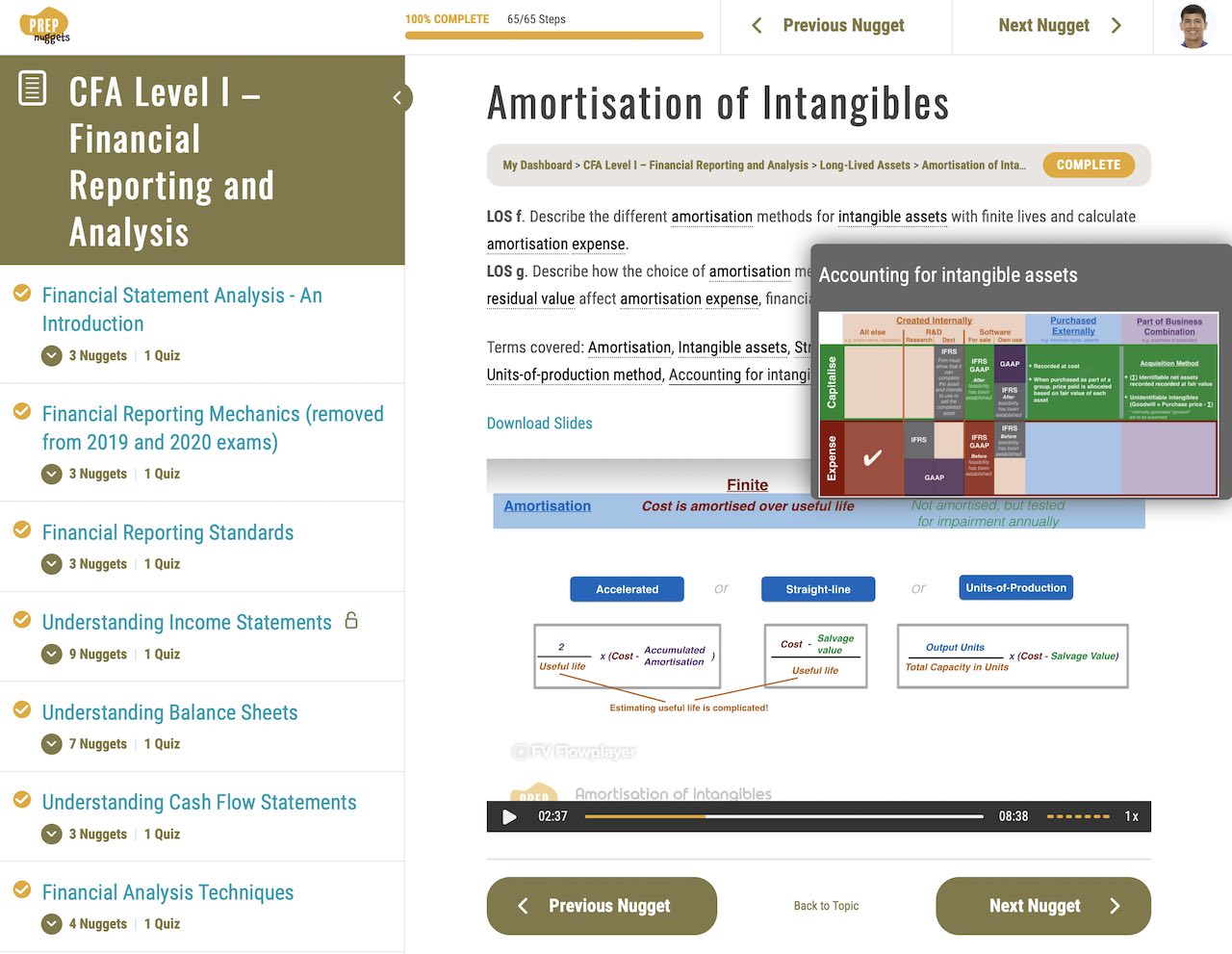
Depreciation/amortisation method that recognises an equal amount of depreciation or amortisation expense over the asset’s useful life. We need to estimate the residual value, and the useful life. Equal depreciation each year = (Cost – Residual value) / Useful life Compare: Double declining balance method
Strategic asset allocation
In the portfolio construction stage, once the capital market expectations have been set, we can proceed to determining the strategic asset allocation. Based on the expected returns, standard deviation of returns, and the correlation of returns of the various asset classes, an efficient frontier can be constructed. With this, you can determine the capital allocation line and the optimal risky ...
Stratified random sampling
Random selection from subgroups. Compare: Simple random sampling
Stripped bond
A bond which has had its coupons “stripped” off (sold separately), such that its yield can be regarded as the yield of a zero-coupon bond. Often used to plot a spot curve.
Strong-form efficient market
The highest level of market efficiency is the strong-form market efficiency. In such a market, security prices fully reflect both public and private information. So by definition, a market that is strong-form efficient is also semi-strong and weak-form efficient. This implies that even insiders with material private information would not be able to earn abnormal returns, as the prices already ...
Structural subordination
Arises in a holding company structure when the debt of operating subsidiaries is serviced by the cash flow and assets of the subsidiaries before funds can be passed to the holding company to service debt at the parent level. Ratings agencies may notch down the parent company’s bonds based on this.
Structural Unemployment
Type of unemployment caused by long-run changes in the economy that eliminate some jobs while new jobs for which the unemployed workers are not qualified. This is a structural problem because the unemployed workers do not currently have the skills needed to perform the jobs that are available.
Structured data
Data that are highly organised in a predefined manner, usually with repeating patterns. Data science tends to be more suitable for traditional structured data which can be plotted onto graphs. Compare: Unstructured data
Structured financial instruments
Securities designed to change the risk profile of an underlying debt security, often by combining a debt security with a derivative The CFA curriculum categorises such structured financial instruments into four broad categories: Capital protected instruments Yield enhancement instruments Participation instruments Leveraged instruments
Studentized residual
LEVEL II To identify outliers, the preferred method is to use studentized residuals. For each data point i, the point is deleted and the regression model is re-estimated with the remaining data points. The residual of this data point is its Y-value minus the predicted Y-value from the regression. This is repeated for all the data points, and we are ...
Style index
Style indexes can be categorised according to market cap, value or growth, or a combination of these characteristics. They are intended to reflect the investing styles of certain investors, such as the small-cap investor, growth investor, and value investor. Some indexes reflect a combination of the market cap, and growth or value styles. Combining the three market-cap groups with value ...
Subordination
A method of credit enhancement where a bond issue is divided into tranches with different seniority of claims. Compare: Time tranching
Subprime loans
In the US, mortgages made to borrowers with lower credit quality are termed subprime loans. LTV ratios should be more stringent for subprime loans. Compare: Prime loans
Sum of squared errors
A measure of the accuracy of a simple linear regression model. It is calculated by summing the squared differences between the observed values and the predicted values of the dependent variable. In simple terms, the SSE is a measure of how well the regression model fits the data. A lower SSE indicates a better fitting model, while a higher SSE ...
Sunk cost
In capital budgeting, costs that has already been incurred. Such costs cannot be avoided, even if the project is eventually not undertaken, so they should not be included in analysis.
Supervised learning
In supervised learning, the input and output data are labelled to allow the algorithm to learn how to map inputs to their desired output. The trained ML algorithms are then given new data to predict outcomes or recognise patterns. For example, a stock prediction machine can be trained using past data like price history, company fundamentals, and economic data ...
Support level
A price level/range in which buyers are eager to buy in anticipation that the price will bounce back up. This can be due to a change in polarity in which a former resistance level becomes a support level.
Supranational bonds
Bonds issued by supranational agencies (e.g. World Bank) Supranationals are not governments, so they don’t have tax revenue. Payments to bondholders are made from donations, investment income, and loan income. Compare: Sovereign bonds, Non-sovereign bonds, Agency bonds
Surety bond
A very slight variation of insurance is a surety bond. The risk being transferred to the insurer is the risk that a third party fails to perform under the terms of a contract or agreement with the organisation. For example, if a key supplier does not deliver its goods on time as per the contract, the insurer has to pay ...
Surety bond
A method of credit enhancement whereby an insurance company promises to make up any shortfall in the cash available to service a debt. Compare: Bank guarantee
Survivorship bias
The bias resulting from a test design that fails to account for companies that have been delisted, funds that are closed, accounts that are terminated, etc. Tends to be an upward bias because terminated accounts/portfolios/stocks tend to have poorer performance.
Sustainable growth rate
A measure of how fast a firm can grow without additional capital from external sources. Can be used to estimate dividend growth rate (g) for Gordon Growth Model. Sustainable growth rate = ROE x Retention rate
Swap contract
An agreement between two parties to exchange a series of future cash flows, on periodic settlement dates, over a certain period. A swap contract can be decomposed into a series of off-market forward contracts. Types: Plain vanilla swap, Interest rate swap
Symmetrical triangle
A type of continuation pattern which represents a pause in an uptrend/downtrend, to be continued when the resistance/support level is breached.
Syndicated loans
Loans from a group of lenders to a single borrower. Compare: Bilateral loan
Syndicated offering
A bond issue that is underwritten by a group of investment banks.
Systematic risk
Systematic risk cannot be avoided and is inherent in the overall market. Examples of factors that constitute systematic risk include interest rates, inflation, political uncertainty, and widespread natural disasters. Unlike unsystematic risk, systematic risk is non-diversifiable because such risk factors affect the market as a whole. Even if a portfolio is well diversified, the other assets would probably do just as ...